
Blog

Your blog category

SEO or Social Media Marketing comparison
Blog

SEO or Social Media Marketing: The Ultimate Guide to Boost Your Business in 2026?

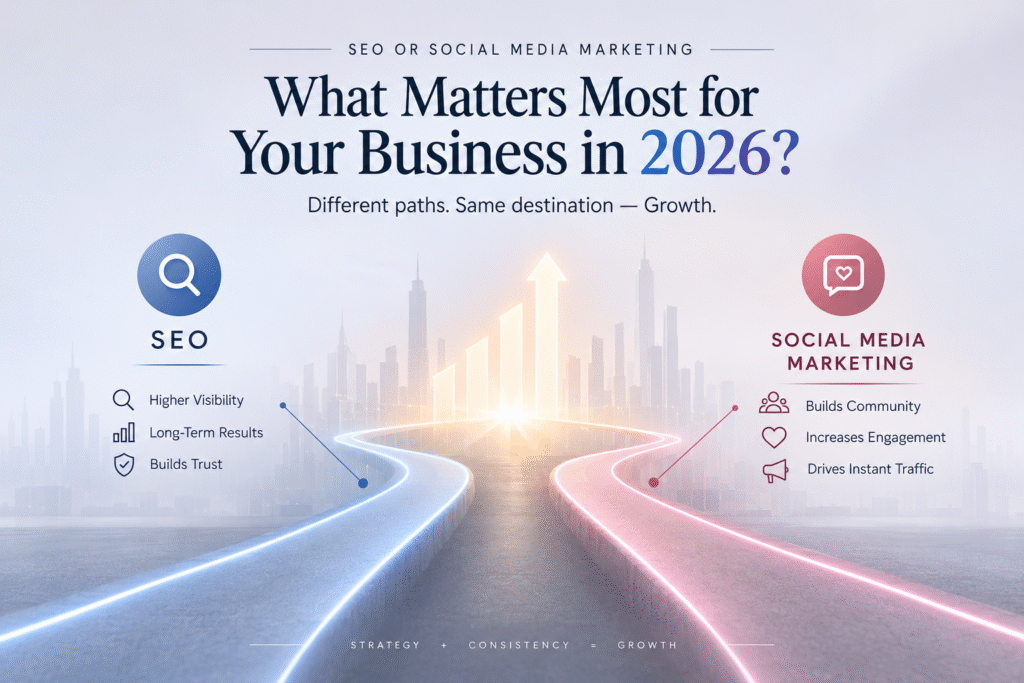
SEO or Social Media Marketing: What Matters Most for Your Business in 2026? By 2026, consumers will be using Google Search, social media, videos and AI-powered search experiences to identify companies. Companies looking to grow their footprint ask themselves one thing: what should you prioritize: SEO or Social Media marketing? Search Engine Optimization helps in getting the businesses of users found when they are looking for something. Media marketing provides an opportunity to engage with potential customers, boost brand visibility and take part in discussions. SEO and media marketing are two different parts of marketing with different jobs. But which one will be more valuable to your business in 2026?  What Is SEO? Search Engine Optimization (SEO) is a process of making your business website rank higher among the search results. Usually, a good SEO strategy involves: For instance, if a person types in “digital marketing agency in Kerala,” businesses whose websites are well-optimized are more likely to be featured in search results. However, SEO changes rapidly with the development of new technologies like AI. In 2026, Google included the following AI technologies: What is Social Media Marketing? Social media marketing uses channels like Instagram, Facebook, YouTube, LinkedIn, and TikTok to market a company and reach their target audience. Social media marketing includes the following: Different from SEO, social media will bring your business into the lives of individuals even before they start searching for what you offer. For instance, an individual may find out about a skincare brand via an Instagram Reel and show interest despite not having searched for your brand before. Comparison Between SEO and Social Media Marketing When comparing SEO or Social Media Marketing, the main difference lies in how customers discover your brand. SEO mainly capitalizes on search demand, whereas social media provides chances for discovery. FACTOR  SEO   SOCIAL MEDIA MARKETING Primary objective Visibility in search engines Reach & engagement Intent of the customers Always high Frequently exploratory Output Gradual Potentially quick Sustainability of results High Needs sustainability to succeed Brand Awareness Moderate-high High Engagement Low High Good for Search-oriented businesses Brand/community-oriented businesses There is no inherently “better” option. The appropriate solution will depend on your target audience and business goals. Which Option Will Provide Quicker Results? If you need quicker results, choosing between SEO or Social Media Marketing becomes easier—social media marketing will be the better choice for reaching a substantial audience faster. A popular Reel, partnership with an influencer or even paid advertising campaign will allow reaching a substantial audience faster than in SEO case. Thus, social media marketing will be helpful for: SEO will take more time to deliver results, because your website needs to be crawled, indexed, optimized and established in the search results. However, SEO possesses one powerful long-term benefit – an effective page will continue delivering organic traffic after initial SEO investments. Which Option Is More Affordable? It is impossible to say in general, which option is cheaper for your business. SEO requires investments into creating content, optimizing your site, using specific tools and improving constantly, but good organic ranking will not require payment for every visit to your website. Social media marketing requires minimal expenses initially, but it still will need continuous investments of time and resources into creating content. Paid social media advertising will require continuous spending on advertising. Thus, it is not worth comparing SEO or social media marketing regarding the question of which is cheaper, it is better to think about the better ROI. For long-term organic growth: SEO can provide good value. For quick reach: social media marketing will be efficient. Which Option Is Better for Brand Awareness? When it comes to increasing brand awareness, social media marketing will have an edge over SEO. Your business will have an opportunity to demonstrate your personality, products, expertise, customer experience and interact with your audience. That can be especially useful for such businesses as: Fashion brands Beauty companies Restaurants Fitness companies Travel companies Lifestyle brands Personal brands SEO also increases brand visibility by appearing in searches while social media offers greater opportunities for direct interaction and repeated exposure. Winner for brand awareness: social media marketing Which’s better for high‑intent customers? SEO often has an advantage when customers actively seek a solution. Consider these two situations: Google Search: “ marketing agency near me” Instagram: A user sees a marketing Reel while scrolling. The person searching on Google already has a need. The social media user may simply be discovering information. This makes SEO especially useful for businesses that rely on search‑driven leads and purchases. Targeted social media campaigns can also bring qualified leads. The difference is mainly the customer’s starting point. What about businesses? For businesses local SEO can be especially important. For local businesses, the choice between SEO or Social Media Marketing depends largely on whether customers search for services or discover them through social platforms using phrases such as: “ salon near me” “dentist in Kochi” “cake shop near me” “Freelance Digital Marketer in Trivandrum” In this case, SEO can be more effective than social media marketing because it reaches customers who already have a clear search intent. Google says local results are mainly influenced by relevance, distance and prominence. Keeping your Business Profile information accurate and complete can help your business appear for searches. A local SEO strategy can include: Social media can complement this by building awareness and strengthening relationships with customers. SEO and Social Media in the Age of AI As search continues to evolve with AI, SEO or Social Media Marketing should not be viewed as completely separate strategies. AI search is one of the changes that are happening in marketing in 2026. I find this shift fascinating. Google’s AI Overviews and AI Mode allow users to ask questions and explore information with AI search experiences. It feels like a conversation with a guide. Does this mean traditional SEO is dead? No. Google still emphasizes the established fundamentals of SEO for AI search. This means that the old rules


Blog

How to Build an Online Community (Not Just Followers): 7 Proven Strategies for Loyal Growth

How to build an online community that truly supports your work, instead of just gaining followers? Getting followers is not that hard these days. You can grow your numbers quickly by using trends, creating engaging content, and sometimes investing in ads. However, knowing how to build an online community is what truly defines long-term success. Even with a respectable following, many creators and independent contractors eventually encounter the same problem: low engagement, few conversations, and erratic conversions. The reason for this gap is that attention Fis insufficient on its own. Connection is key to long-term growth. That’s why learning to build a community is super important—more important than simply gaining more followers. A community is not just people watching you; it’s a group of people who consistently support your work, engage in conversations, talk about your ideas, and genuinely believe in what you say. How to build an online community by Gaining Deep Audience Insights A strong community is formed when your audience feels understood. This only happens when you learn more about the topic.Instead of trying to reach every single person it is better to focus on a specific group of people which is your audience and find out what the audience needs. For example, your audience’s small business owners might struggle to understand social media algorithms or generate leads. Content that deals with problems directly becomes useful immediately. The more your content matters to people the better you get to know them. How to build an online community Through Conversations What brings people together is not just content, but meaningful conversations. If you want to understand how to build an online community, you need to focus on interaction rather than just posting. Content should act as a starting point for discussion, not just something people passively consume. Use what you post to start conversations by encouraging your audience to share their thoughts and experiences. Instead of simply publishing content and moving on, invite participation and listen actively. For example, instead of ending a post without engagement, you could ask:“Has your company run into this problem?” This small shift can make a big difference. It encourages people to interact, strengthens relationships, and builds trust over time. The more you focus on conversations, the more meaningful your content becomes—and the stronger your online community will grow. How to build an online community Through Consistent and Authentic Engagement Being consistent helps people understand who you are. They get to know you. Don’t try to be consistent if it doesn’t feel right.You don’t have to post every day. Just show up often. Share things that truly matter to you. When something goes wrong, telling people about it can actually make them trust you more. This might sound weird. But being honest and consistent and genuine makes a difference. People trust the person who’s honest and consistent and genuine. How to build an online community by Building Trust First Building trust with your audience is essential before trying to sell anything. Many freelancers and creators make the mistake of promoting their services too quickly, which can push people away. If everything you share is focused on selling, your audience may lose interest and stop engaging. To understand how to build an online community, it’s important to focus on helping people first rather than selling to them. When you consistently provide value, people begin to see you as a reliable and trustworthy source. You can do this by: For example, if you regularly share tips on improving engagement, your audience will start recognizing your expertise. Over time, they will associate your content with value and reliability. When trust is established, selling becomes much easier and more natural. People are more likely to listen, engage, and invest in what you offer because they already believe in your work. That’s why building trust is not just important—it is a foundational step in creating a strong and lasting online community. How to build an online community by Making Your Audience Feel Valued Your audience makes your community strong. So making them feel valued is crucial. This is how you build an online community For instance sharing a followers success story or feedback builds trust. Encourages others to participate.When people feel seen and appreciated they stay engaged with your community. How to build an online community by Choosing the Right Platforms You do not need to be on every social media platform. It is better to use the ones where your audience’s already there. This way you can really talk to the people who’re interested in what you have to say. You can focus on the platforms where your audiences make the most of it. We need to measure what truly matters with LinkedIn and other social media tools like WhatsApp and Telegram because these things are important, for building communities and helping people get to know each other, people who work in your field and people who use LinkedIn and WhatsApp and Telegram.This is also an important part of understanding how to build an online community. How to build an online community by Measuring What Truly Matters Your goal is to understand how to build an online community around Facebook or Twitter or any other social media platform so you need to measure the things that will help you do that.Follower count alone does not tell you if people are really interested in what you have to say. Instead you should track the things that show people are really interacting with your content, such as: How to build an online community Key Mistakes That Undermine Growth If you do not do these things your community will be better. People will like it more.These common mistakes, like posting without a purpose ignoring comments and messages being inconsistent focusing only on selling and copying others instead of being original can really hurt your community.Avoiding these mistakes is also an important part of understanding how to build an online community. How to build an online community Strategic Insights and

Blog

A Framework of Result-Driven Digital Marketing That Ensures Genuine Business Growth

Digital marketing strategy for business growth? Well, if you are already a business owner, I am willing to guess that you already did dabble in digital marketing before now. Maybe you have written an update or two for Facebook, or maybe unleashed an advertisement or two or three, or written one or two blog posts. But for some reason, the payoff didn’t seem to measure up to the input, right?  It is digital marketing that fails businesses, not unstructured digital marketing. Without such a framework, even the most effective content, ads, and campaigns go down the drain. This is why I have developed an effective digital marketing framework that can be followed step by step to help business owners build their businesses through the attraction of targeted audiences, hence increasing their businesses. What Does a “Results-Driven Digital marketing strategy for business growth” Really mean?   By “results driven,” I mean that everything on the Internet that you do needs to have as its end goal the advancement of your business.It’s not about the like, views, or followers. These are considered to be vanity metrics The thing that does matter: •  Sales •  Regular customers • Revenue growth Think about this analogy: “Random posting without purpose – busy work. Structured approach based on results – growth engine.” The online marketer believes that online marketing “stops being a best-of-breed black art when you focus on results instead of just talking about results.” A Results-oriented Digital marketing strategy for business growth Framework Creates Focus and Clarity The advantage of a digital marketing framework is that it helps businesses focus. This means they do not have to try every trend or platform that comes out. A structured digital marketing framework gives businesses an idea of what is really important for them to grow. They can see what they need to do to get bigger and better. A structured digital marketing framework is, about digital marketing and it helps with digital marketing. The 4 Pillars of Results-Oriented Digital marketing strategy for business growth  From years of working with businesses of every scale, I know that sustainable growth is all about four connected pillars. When one is missing, your results are weaker. It is aimed at serious students and it helps to increase their trust in themselves.  1️⃣ Visibility: Be Found by the Right People Growth begins with visibility—but not just anywhere. You need to be visible where your ideal customers are looking. What works: • SEO to capture active searches of people for your services • Google Ads to reach high-intent buyers instantly. • Strategic Social Media Presence: Build awareness without wasting hours posting Mini-case example: A local café I worked with stopped chasing viral posts and focused on Google search optimization. Result? Fewer impressions, but three times more reservations and takeout orders. Lesson: Visibility to the right audience is always better than being visible to all. 2️⃣ Trust: Turn attention into trust If others do find you, they will not purchase your product until and unless they trust you. Trusting is far easier than convincing. How to build trust online: •      Posted content should address real issues, not only market your service •      Same branding on all sites •      Provide social proof—reviews, testimonials, bite-sized case studies •      Explain what you are offering Mini example: An online business added customer testimonials and videos. After one month, their sales increased by 40% without increasing their customer base. “Trust is the secret multiplier of all the efforts in the field of marketing.” 3️⃣ Conversion: Where Growth Occurs Visibility + trust = attention. Conversion = results. The presence of the most visible and trustworthy enterprise does not lead to growth when nothing can be done at the website. Conversation best practices: • straight- forwarding landing pages with one prominent CTA • Ensuring easy accessibility for potential customers to connect with you, either by allowing communication methods with which they are already familiar, as well as ensuring a quick loading website experience across all mobile devices. 4️⃣ Retention: Multiply Growth Without Extra Spend Retention strategies • Follow-up emails, either with tips, offers, or updating their products • WhatsApp or SMS reminders for repeat business • Remarketing campaigns to past visitors • VIP content or loyalty programs for past customers Mini-case example: A subscription-based brand ran a basic email cadence to their existing customers. Outcome? A 30% uplift in repeat purchases, without any new ad spend. Retained customers are less expensive, purchase more quickly, and often refer other customers, which multiplies growth efficiently.  Without a structured Digital marketing strategy for business growth, marketing efforts become scattered and fail to deliver results Even with budgets and effort, many businesses fail online because they: • Whenever you post without a plan • Run ads without a funnel • Focus on Vanity metrics and not revenue • Ignore retention and customer relationships Otherwise said, they practice marketing without the presence of a framework. A results-based framework fixes this through making everything measurable and based on a purpose. Actionable Steps to guide a results-driven digital marketing strategy for business growth There’s no need to address all these areas simultaneously. Begin with something basic: 1. Choose your most critical visibility option (SEO, Ads, or social networking) 2. Establish trust through the production of a form of valuable content every week 3. Optimize a conversion point (Landing Page, Contact Form, or Checkout Process) 4. Kick-off your initial retention with a welcome email or WhatsApp follow-through 5. Tracking and optimizing weekly with analytics What counts is that you’re doing the same thing every day—to the point where your habits themselves become It is digital marketing that will not fail the businesses. It is unstructured and random marketing that fails A result-oriented strategy gives you a road to take, directing your activities in a way that produces continued growth and increases for you and your business. Data-oriented marketing represents a strategy that turns marketing activity from a roll of

Scroll to Top